.png)


.png)


.png)

Battery storage connectors are electrical connection components used to connect battery modules, battery packs, inverters, and other equipment within battery energy storage systems (BESS). Depending on their position in the system, they may serve DC power connections, AC interfaces, or communication circuits. Their voltage, current, insulation, and mechanical specifications must match the intended circuit and installation conditions. This guide explains the main types, the specifications that matter, how to match voltage and current, and how to choose a supplier — with real HANDA product examples throughout.
HANDA provides battery storage connector solutions for energy storage inverters, battery packs, and related equipment. Its product range includes cable connectors, panel-mount connectors, on-board connectors, and battery PACK interfaces. Buyers can review the available configurations and HANDA's energy storage connector range, and request technical documentation for specific models.
As residential, commercial, and grid-scale storage grows, buyers increasingly compare connector families by electrical rating, mounting style, and documented compatibility rather than by shape alone. A considered choice at the design stage avoids mismating, overheating, and rework during installation.
Table of Contents ▼
- What Is a Battery Storage Connector?
- Types of Battery Storage Connectors
- Applications of Battery Storage Connectors
- Key Specifications to Consider
- Choosing the Right Current and Voltage Rating
- How to Choose a Battery Storage Connector
- HANDA Battery Storage Connector Solutions
- Battery Storage Connector vs. Solar Connector
- Choosing a Reliable Connector Manufacturer
- Installation and Maintenance Considerations
- Frequently Asked Questions
- Conclusion
1. What Is a Battery Storage Connector?
A battery storage connector is an interface component designed to join conductors in an energy storage circuit — from a cell harness to the DC port of an inverter, an AC equipment interface, or a communication line. It typically combines an insulating housing, conductive contacts, a locking structure, and sealing parts. Its job is to maintain a low-resistance, mechanically stable, environmentally protected connection for the life of the installation.
1.1 What It Connects in a BESS
In a typical battery energy storage system, cells are assembled into modules, modules into racks or packs, and packs are wired to a battery cabinet and then to an inverter or power conversion system (PCS). Such connectors appear at almost every one of these boundaries: on module leads, between racks, at the cabinet feed-through, and on the inverter's ES (energy storage) port. They let a system be assembled, tested, and serviced as separable subassemblies instead of one permanent harness.
1.2 Why a Dedicated Connector Matters
Storage circuits combine conditions that ordinary low-voltage connectors are not specified for: sustained high DC current, elevated system voltage, confined cabinet space, and elevated ambient temperature near power electronics. A connector that is merely "the right shape" can develop high contact resistance, loosen under vibration, or admit moisture. The connectors are specified as a system — contact geometry, housing material, seal design, cable range, and mating pair — and should be used as an approved matched set.
2. Types of Battery Storage Connectors
Battery storage connectors are grouped mainly by how they mount and where they sit in the system. The comparison below is the fastest way to narrow a shortlist before comparing individual datasheets.
| Connector Type | Connection Method | Typical Application |
|---|---|---|
| Cable-to-Cable | Cable plug / socket | Battery and inverter cables |
| Panel-Mount | Enclosure feed-through | Battery cabinets and inverters |
| On-Board | PCB soldered pins | Internal inverter connections |
| Terminal Block | Screw or copper plate | Equipment power interfaces |
| Floating Connector | Blind-mate | Battery PACK assemblies |

2.1 Cable-to-Cable Battery Storage Connectors
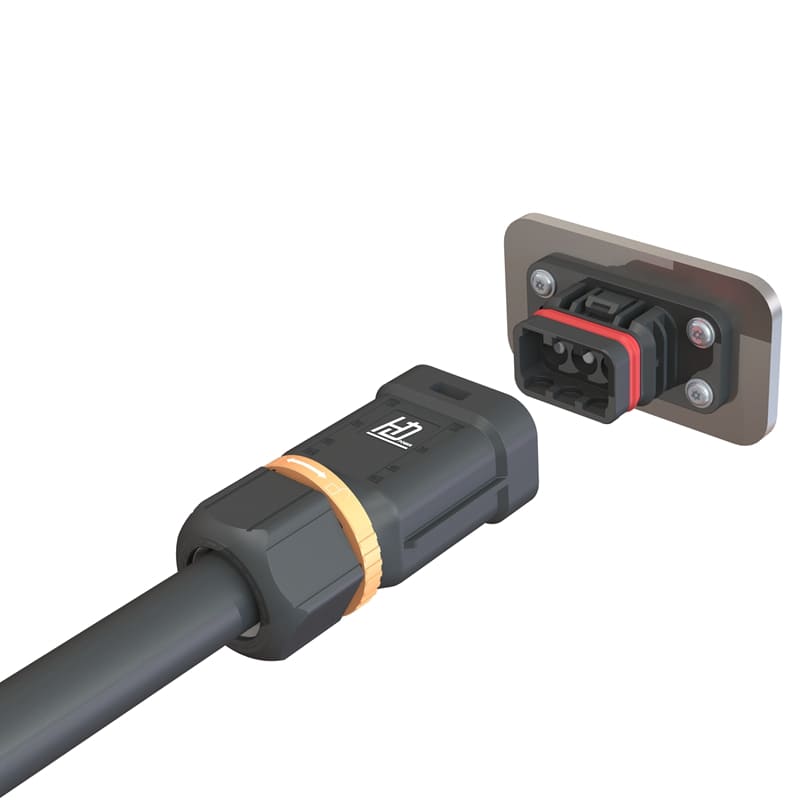
These are plug-and-socket pairs crimped onto the ends of two cables. They are the most common way to join a battery lead to an inverter cable or to extend a harness. They are valued for quick assembly and serviceability. HANDA's Energy Storage Male Female Cable Connector is published at 1000V DC with a 12kV impulse rating, and its screwing-type sibling, the ES Battery Cable Connector, is specified for 10mm² and 16mm² conductors.
2.2 Panel-Mount Battery Storage Connectors
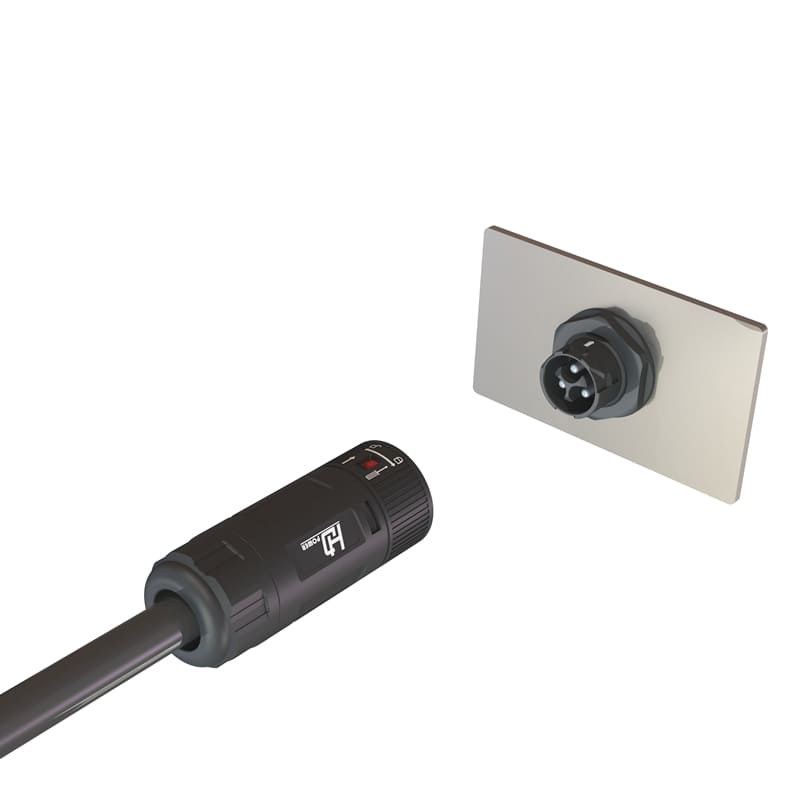
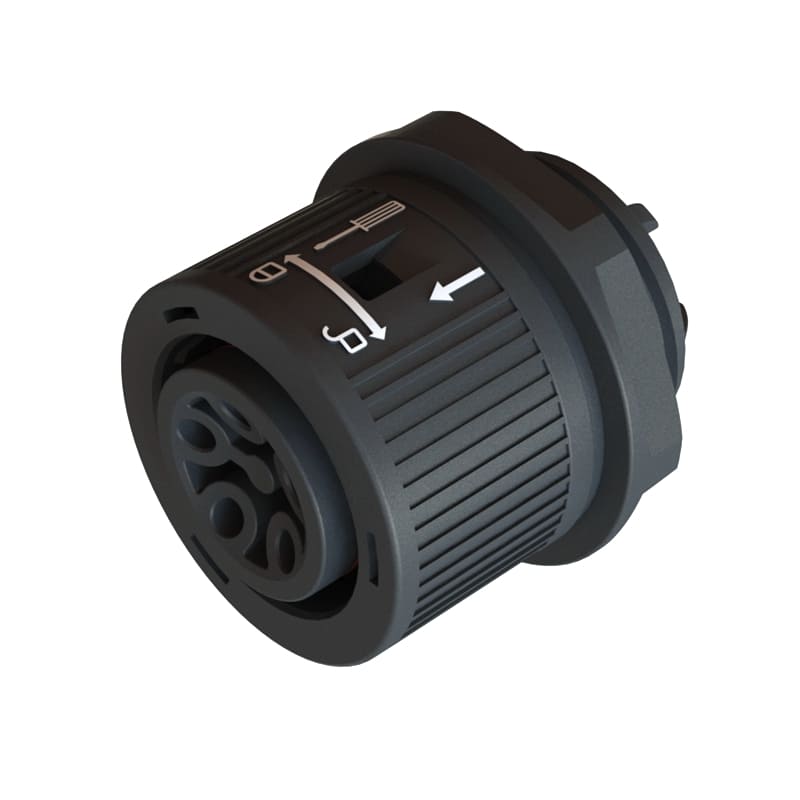
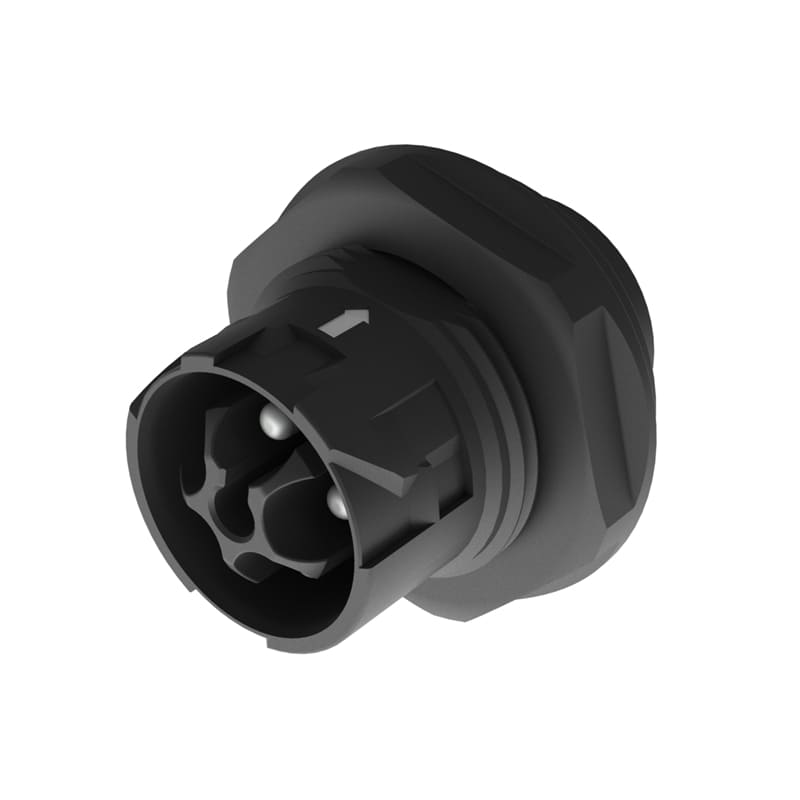
A panel-mount connector passes through a cabinet or inverter wall and provides an external interface while the wiring stays inside the enclosure. Buyers should check mounting dimensions, thread size, seal design, and terminal configuration. HANDA's Energy Storage Solar Male Female Panel Mount Connector, models HDC-70f3 and HDC-70m3, is published at 1000V DC with IP65/IP68 (1m, 1h) protection and rated currents of 70A at 10mm², 55A at 6mm², and 41A at 4mm².
2.3 On-Board Battery Storage Connectors
On-board designs integrate directly with a printed circuit board inside the inverter, often replacing an internal wiring harness. HANDA's Energy Storage Panel Mount On-Board Connector uses all-in-one pins that solder directly to the PCB, a change from M12 to M20 sizing intended to reduce contact-related heating. The on-board connector with NTC, models HDC-41f2L and HDC-41m2L, adds integrated temperature monitoring and is published at 1500V DC, 16kV impulse, and 55A at 85℃.
2.4 Terminal Block Connectors for Energy Storage Equipment
For higher currents inside a cabinet, terminal blocks and stud-type connectors join cables or copper plates. HANDA publishes a 120A 2-pin terminal block and a 250A 2-pin terminal block, each combining positive and negative poles in one body, plus a 120A ES battery connector rated at 1500V DC for battery-pack-to-inverter links. Note that the published ratings differ by circuit: the 250A terminal block is specified at 1000V AC, while the DC battery connectors are specified at 1000V DC or 1500V DC.
2.5 Battery Pack and Floating Connectors
Where packs must mate blind inside a rack, floating connectors tolerate misalignment. HANDA's Floating Battery PACK Connector family combines three main power contacts with eighteen communication contacts in one all-in-one interface. It is described as returning to its original position after floating for insertion at up to a 15-degree tilt. The family is published at 1500V DC and 8kV impulse, with different current configurations: model HDC-70i3f2 is rated 70A for 6–16mm², and HDC-120i3f2 is rated 120A for 25mm².
3. Applications of Battery Storage Connectors
Connector choice follows the equipment and the circuit at each point in the system.
3.1 Battery Energy Storage Systems (BESS)
Containerized and rack-based BESS use a mix of cable, panel-mount, and busbar connections from cell to PCS; current density and service access drive the choice.
3.2 Residential and Commercial Storage
Wall-mounted home batteries favor compact cable and on-board connectors that fit a sealed enclosure. C&I systems balance moderate voltage with higher cycle counts, so mating-cycle rating and locking robustness matter more.
3.3 Battery Cabinets and Racks
Cabinets concentrate many strings in one envelope. Panel-mount feed-throughs and terminal blocks keep wiring orderly and let sections be isolated during maintenance.
3.4 Energy Storage Inverters and PCS
Hybrid and storage inverters need a defined ES port; on-board connectors soldered to the PCB save internal space. At the PCS interface, selection depends on system architecture, operating voltage, power rating, and required current — verify the exact connection point rather than assuming a fixed rule.
4. Key Specifications to Consider
A datasheet is a set of conditions, not a single number. Compare the same fields across candidates, and check the test conditions behind each value.
| Specification | Why It Matters | What to Check |
|---|---|---|
| Rated Voltage | Must meet or exceed the maximum system voltage | 1000V DC, 1500V DC, or 1000V AC as published |
| Rated Current | Determines power-carrying capability and heating | Value at the stated temperature and cable size |
| Impulse Voltage | Reflects transient withstand capability | Published kV value for the exact model |
| Contact Resistance | Affects resistive heating and efficiency | Limit plus measurement conditions |
| Insulation Resistance | Indicates insulation quality in wet conditions | Published minimum, e.g. ≥500MΩ |
| IP Rating | Protection against dust and water ingress | Whether it applies mated, unmated, or installed |
| Operating Temperature | Critical near inverters and in outdoor cabinets | Full range, e.g. −40℃ to 85℃ |
| Mating Cycles | Relevant where packs are serviced repeatedly | Published cycle count |
| Cable Size | Must match conductor cross-section and OD | Approved conductor range and gland range |
| Certification | Supports compliance and system validation | Scope covering the exact part number |
5. Choosing the Right Current and Voltage Rating
Voltage and current are the two fields most often misread in a connector comparison. They should be derived from the system, not from the catalogue.
5.1 Voltage: 1000V vs 1500V DC
Select the rating from the maximum system voltage and applicable safety requirements. HANDA's published range includes both 1000V DC products — such as the ES cable and standard panel-mount connectors — and 1500V DC products such as the NTC on-board connector and the 120A ES battery connector. Neither is universally "better": the correct value is the one that covers the system it is installed in.
5.2 Current: Match the Real Duty Cycle
Current ratings are tied to conditions. HANDA publishes, for example, 55A at 85℃ for the on-board connector, 70A at 10mm² for the HDC-70 panel-mount models, 120A for the ES battery connector, and 250A for the larger terminal block. Treat these as model-specific figures, and confirm the continuous and peak duty, conductor size, and ambient temperature before choosing.
6. How to Choose a Battery Storage Connector
Use this sequence to move from a system requirement to a specific part.
Step 1: Define the system voltage
Record the maximum DC voltage of the string or pack and the applicable safety margin.
Step 2: Determine continuous and peak current
Account for charge and discharge duty, not just nameplate capacity.
Step 3: Select the connection type
Choose among cable, panel-mount, on-board, terminal block, busbar, or floating formats based on where the connection sits.
Step 4: Check the installation environment
Consider indoor or outdoor placement, dust and water exposure, temperature, and vibration; then verify the IP rating under the actual mated condition.
Step 5: Verify mechanical compatibility
Confirm cable cross-section and outside diameter, mounting footprint, polarity, locking method, and that the male and female halves are an approved pair.
Step 6: Validate documentation and supply
Request the datasheet, drawings, certificates, and test reports for the exact model, and confirm lead time and customization options with the supplier.
7. HANDA Battery Storage Connector Solutions
HANDA publishes a portfolio that spans cable, panel-mount, on-board, terminal, and battery-pack interfaces. The table maps each family and model to a typical location; confirm current specifications on the linked product page.
| HANDA Solution | Model | Typical Application | Published Key Rating |
|---|---|---|---|
| ES Male Female Cable Connector | See product page | Battery-to-inverter cable link | 1000V DC, 12kV impulse |
| ES Panel Mount Connector | HDC-70f3 / HDC-70m3 | Inverter / cabinet feed-through | 1000V DC, up to 70A, IP65/IP68 |
| ES On-Board Connector | See product page | Internal inverter PCB connection | 1000V DC, 55A at 85℃ |
| ES On-Board + NTC | HDC-41f2L / HDC-41m2L | PCB link with temperature monitoring | 1500V DC, 16kV, 55A |
| 120A 2-Pin Terminal Block | HDB-120i2 | Cabinet power distribution | 1000V (III/2), 100A rated current — verify latest datasheet |
| 250A 2-Pin Terminal Block | HDB-100i5 | Higher-current battery applications | 1000V AC (III/2), 250A |
| 120A ES Battery Connector | See product page | Battery pack to inverter | 1500V DC, 120A, ≤0.1mΩ |
| Floating Battery PACK Connector | HDC-70i3f2 / HDC-120i3f2 | Blind-mate battery PACK interface | 1500V DC, 70A / 120A, 3+18 pin |

ES Battery Cable Connector
A screwing-type connector published for 10mm² and 16mm² conductors, rated at 1000V DC, 12kV impulse, and 70A at 85℃, with contact resistance ≤0.25mΩ.

On-Board Connector with NTC
An M20 panel on-board design with all-in-one pins soldered to the PCB, published at 1500V DC, 16kV impulse, 55A at 85℃, IP65/IP68, and contact resistance ≤0.3mΩ.

120A ES Battery Connector
A panel-and-cable battery connector for inverters with battery packs, published at 1500V DC, 8000V impulse, 120A, and contact resistance ≤0.1mΩ.

Floating Battery PACK Connector
A blind-mate 3+18-pin interface combining power and communication contacts, published at 1500V DC with 70A (HDC-70i3f2) and 120A (HDC-120i3f2) configurations.
Buyers can review the full HANDA energy storage connector range, request a product datasheet, or discuss custom structures, cable assemblies, and labeling for OEM projects.
8. Battery Storage Connector vs. Solar Connector
Both carry DC in many systems, but they are not interchangeable. A solar PV connector is optimized for outdoor strings; a storage connector is optimized for high-current power transfer inside cabinets and inverters. Treat them as separate families.
| Feature | Battery Storage Connector | Solar PV Connector |
|---|---|---|
| Primary application | Battery systems, BESS, inverters, PCS | PV modules and strings |
| Main connection | Battery pack, cabinet, inverter DC port | PV module leads and extension cables |
| Current requirement | Often higher, e.g. 55A–250A families | Depends on string design |
| Typical environment | Battery cabinet, rack, inverter interior | Outdoor PV array |
| Design priority | High-current transfer and system safety | Outdoor durability and PV compatibility |
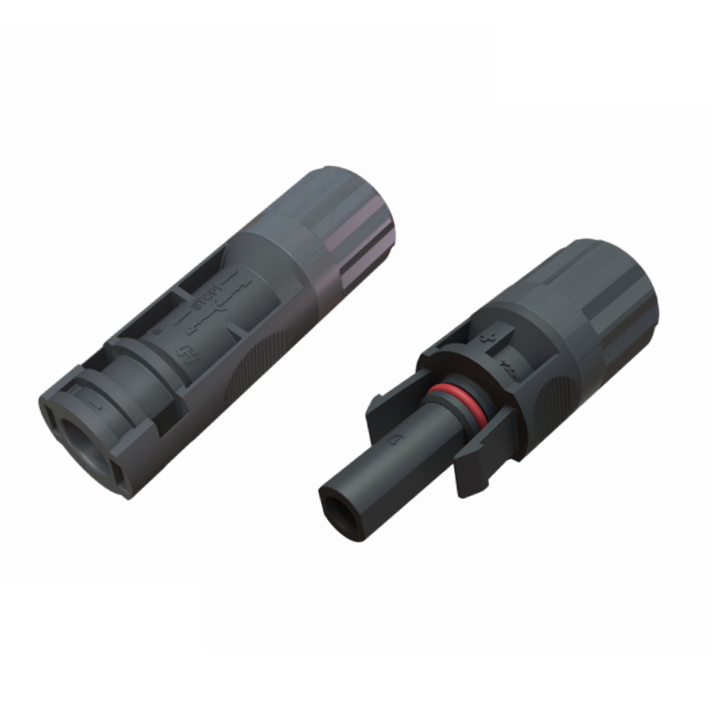
HANDA addresses the mismating risk directly: its energy storage connectors use a different color and a 90-degree twisted mating face so they cannot be mated with HD solar DC connectors despite a similar size. This fool-proofing is a practical reason to keep storage and solar connector families separate in a bill of materials.
9. Choosing a Reliable Connector Manufacturer
For procurement teams, the supplier matters as much as the part. Evaluate a connector manufacturer on evidence, not adjectives.
9.1 Product Range
Can the supplier cover cable, panel-mount, on-board, terminal, and battery-pack formats from one source, so a project is not dependent on several incompatible mating systems?
9.2 Technical Documentation
Request datasheets, drawings, electrical specifications, and test reports, and confirm that the documents cover the exact model being purchased.
9.3 Manufacturing and Quality Control
Ask specifically about tooling, injection molding, assembly, and electrical testing capabilities, and about the quality controls applied to each production batch.
9.4 Customization Capability
For OEM projects, confirm options for connector structure, cable assembly, packaging, labeling, and samples, while keeping technical suitability the first priority.
9.5 Application Experience
Look for a supplier whose published products are already used in BESS, inverter, and battery-pack contexts, and who can discuss connection requirements in those terms.
9.6 How to Verify a Battery Storage Connector Supplier
Before placing a volume order, ask a prospective supplier to demonstrate the following with documents and samples:
- Product datasheets and dimensional drawings for the exact model
- Electrical and mechanical test reports, with test conditions stated
- Applicable certificates, checked against the specific part number
- Sample evaluation under the buyer's real cable and mounting conditions
- Evidence of production consistency and batch-level quality control
- Delivery capability and lead time for the required volume
10. Installation and Maintenance Considerations
Even a correctly specified connector will underperform if it is assembled badly.
- Use the specified cable, contact, crimping tool, and assembly procedure; do not substitute terminals or improvise tooling.
- Before commissioning, confirm that halves are fully mated and locked, glands are tightened, and seals are intact.
- Keep approved mating pairs together; do not combine male and female halves from different manufacturers unless compatibility is documented.
- Follow the project maintenance plan. Where appropriate, qualified personnel can use visual inspection and thermal imaging to find abnormal heating.
11. Frequently Asked Questions
1. What is a battery storage connector?
2. What is the difference between a battery storage connector and a solar connector?
3. What voltage ratings are available for battery storage connectors?
4. How do I choose the right battery storage connector?
5. Are battery storage connectors suitable for BESS applications?
6. Can battery storage connectors be customized?
7. What does IP65/IP68 mean for a connector?
12. Conclusion
Choosing a battery storage connector means matching electrical ratings, cable and mounting geometry, environmental protection, and a manufacturer-approved mating pair — not just finding a plug that fits. A clear specification reduces mismating and overheating risks. HANDA offers cable, panel-mount, on-board, terminal block, and battery-pack options; explore the energy storage connector range and request documentation for your exact model.
Ready to discuss your battery storage connector requirements? Share your voltage, current, cable size, and mounting needs with HANDA.

.png)


.png)
.png)


.png)


.png)
.png)
.png)